
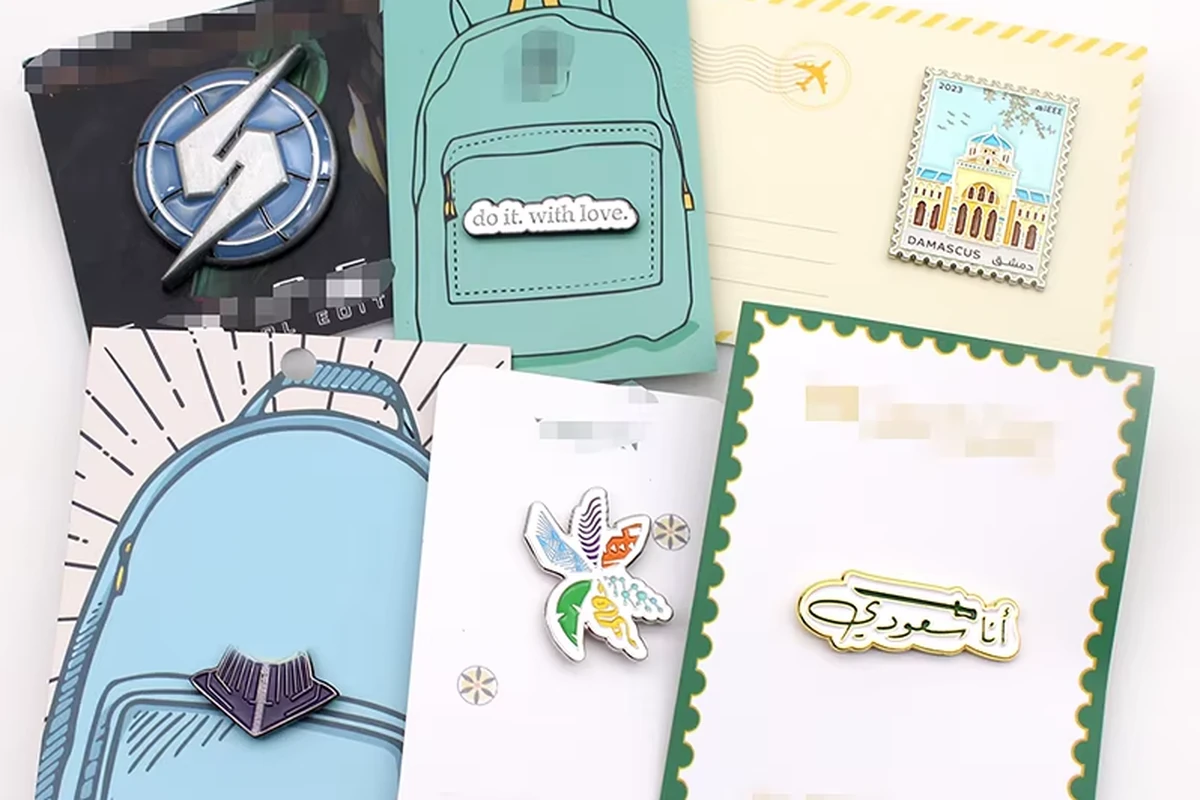
Choose packaging around the complete pin, the way it will be issued or sold, and the protection it needs through delivery. Measure the assembled product including its backing, define the visible presentation and removal method, then approve the pin and packaging together. A package that looks suitable in a front photo may still leave the reverse cramped or the product difficult to remove.
WisePins offers individual poly bags, backing cards, paper gift boxes, velvet pouches and custom branded packaging, with suitability confirmed for the product and design. These are options to discuss, not a fixed package that automatically accompanies every pin.
1. Start with the recipient and distribution method
Write down what happens to the pin from receipt to use. Will a retail team hang it for sale, an organizer hand it out, or a recipient open it as a gift? The answer determines which presentation information and handling tasks the packaging must support.
| Situation | Useful packaging direction to discuss | Decision to settle |
|---|---|---|
| Retail display | Backing card and any agreed individual protection | Display orientation, required wording and product visibility |
| Event handout | Individual protection or a simple card presentation | Speed of distribution and quantities per inner pack |
| Corporate or commemorative gift | Paper gift box, pouch or another branded presentation | Opening experience, fit and the complete approved appearance |
| Membership issue | Card or package carrying supporting information | Which message belongs on the pin and which on the package |
| Multi-item set | A separately reviewed arrangement | Item positions, separation, assembly and removal |
Build the shortlist around the most important job:
- Choose a backing card first when the pin must remain visible with brand or product information. If retail hanging is required, specify the display arrangement and check the loaded card in it. A card by itself does not enclose the item.
- Choose a pouch first when a concealed gift presentation and a flexible enclosure suit the project. If a logo, barcode or message must be readable before opening, specify where it goes; do not assume the pouch provides a flat printed display area. Review whether a card or support is also needed.
- Choose a paper gift box first when a defined opening presentation or positioned multi-item set matters. Specify the support and usable interior, then include the extra assembled size in storage and freight comparisons.
- Choose an individual poly bag first when simple individual enclosure is the main task. Add a card or label only where the display or distribution plan needs it.
This gives each proposed option a reason to exist. At a high-volume event desk, compare the time needed to issue the packaged items. For a retail display, compare what customers can see before opening. For gifting, compare the loaded opening and removal experience.
2. Define what each quoted option includes
Packaging names are incomplete specifications. Ask for the dimensions, material description, printed content, assembly and supply arrangement for the option being quoted. “Backing card included” does not tell you whether artwork preparation, printing, mounting or another protective layer is part of the price.
| Option | What to describe | What to review on the sample |
|---|---|---|
| Individual poly bag | Product orientation, closure and any requested labeling | Complete item fit and the way it is removed |
| Backing card | Finished card size, print, mounting and presentation | Front layout, reverse clearance and attachment position |
| Paper gift box | Usable interior, product support and closure | Loaded fit, movement and opening/removal |
| Velvet pouch | Proposed size, closure and branding if requested | Insertion, complete product fit and presentation |
| Custom branded packaging | Structure, artwork, components and assembly | The actual specified combination |
Ask whether the pin arrives already assembled with its packaging or whether your team performs that step. If several badges go into one package, define the set and the quantity of sets separately from the number of individual pins.
Do not assume a package material name establishes environmental performance or certification. If such an attribute is a purchasing requirement, identify the specific requirement and ask what relevant evidence can be supplied for that product.
3. Measure the complete occupied space
Record the pin's width and height in its intended orientation. Then include the post, closure, reverse details and any card or support that travels with it. Distinguish the front outline from the occupied dimensions of the complete assembly.
For a box or fitted presentation, label whether each dimension describes the product, a support cavity, the usable interior or the closed exterior. Those are different measurements used for different decisions. The fit is reviewed against the complete product; shipping and storage need the packed exterior.
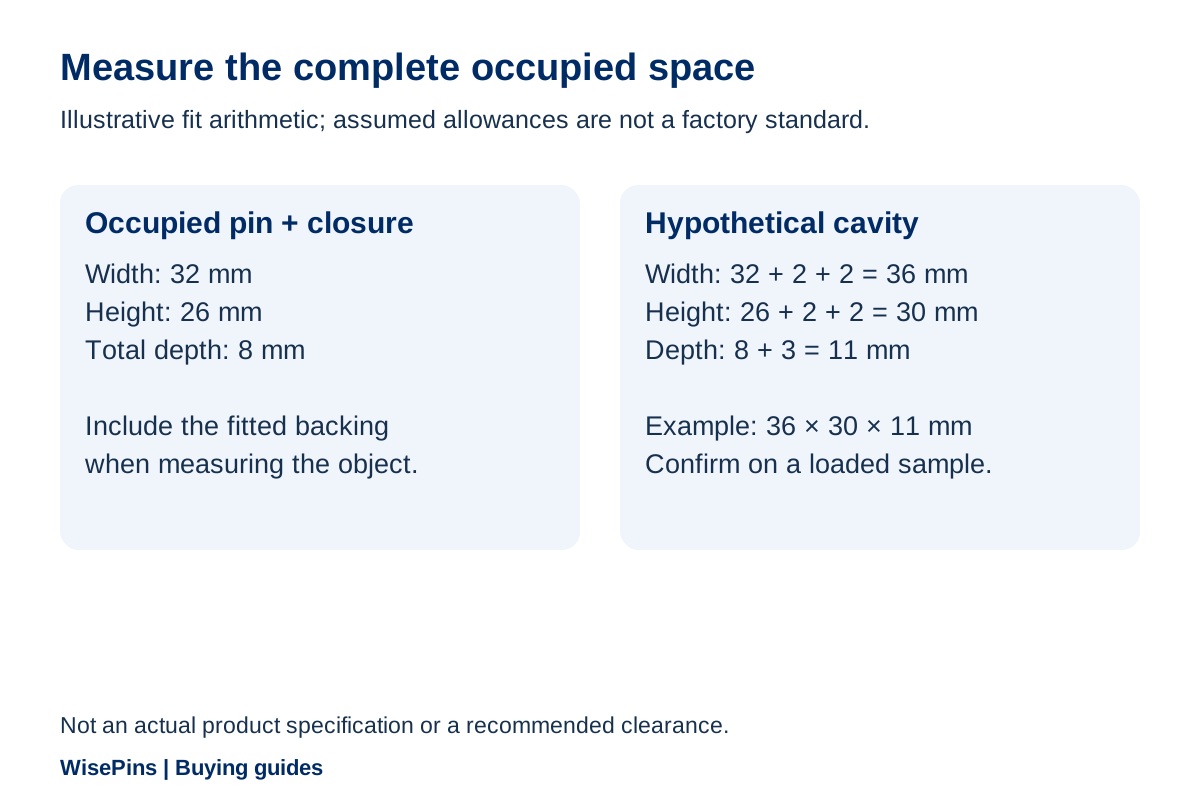
Illustrative arithmetic example: suppose a complete pin assembly occupies 32 × 26 × 8 mm. A proposed rectangular cavity has an assumed 2 mm of clearance at each side in plan view and an assumed 3 mm of total additional depth:
- Cavity width: 32 + 2 + 2 = 36 mm.
- Cavity height: 26 + 2 + 2 = 30 mm.
- Cavity depth: 8 + 3 = 11 mm.
These are invented inputs demonstrating how to label a calculation. They are not WisePins product dimensions, recommended clearance or a universal packaging tolerance. Support material, insertion direction, closure and removal access can change the required space.
Ask for the proposed structure and evaluate a loaded sample. A cavity's arithmetic dimensions alone do not prove that the recipient can insert or remove the pin, or that the support will hold it appropriately.
4. Align the backing card with the reverse of the pin
Agree the attachment type and placement before finalizing card holes or slots. Keep a dimensioned reverse reference linked to the upright front. A change to the post arrangement can affect mounting even when the face artwork is unchanged.
Review a card as an assembled presentation. Important print may be hidden by the pin, its attachment or the way the card is held on display. Confirm the visible product position, brand wording, any required product information and the reverse layout together.
| Card check | Practical action |
|---|---|
| Product placement | View the actual pin mounted in its intended position |
| Visible wording | Check what remains readable with the product fitted |
| Attachment alignment | Compare the actual reverse with proposed holes or slots |
| Reverse space | Check that the closure and other elements have the agreed room |
| Recipient handling | Remove and refit as intended using the actual components |
| Artwork revision | Keep the approved card version with the pin specification |
If your team supplies a card, ask which measurements and mounting details the manufacturer needs before final files are released. Do not assume the factory can adjust a separately supplied print run after the pin is completed.
The pin backing guide connects attachment selection with reverse clearance and handling. Treat the pin and card as one assembly at final approval.
5. Check the packed product through its handling stages
Presentation packaging and transport protection serve related but different purposes. A gift box may make the opening experience attractive while the shipment still needs a suitable outer packing arrangement. Ask what is proposed for both stages.
Review the loaded presentation sample before closing the specification. Observe whether the product sits as intended, whether parts press against the closure, and whether another item or printed surface makes unwanted contact. Explain any concern by location and handling step.
Then confirm the intended shipment packing: pieces or sets per inner pack, number of packs, separation of designs and the outer packing information. Discuss any special protection or evidence requirements for the actual product and route rather than assuming the presentation package alone answers them.
Photographs can show the assembly and visible contact points. They cannot establish the result of an unperformed transit or performance test. If a specific assessment is required, agree the method and scope before ordering and keep that evidence with the approved specification.
6. Compare packaging cost and freight on the same basis
Separate the pin, packaging components, printing, mounting or assembly, and delivery charges when comparing proposals. Define three units before doing the arithmetic: a piece is one pin; a set is the specified combination sold or issued together; an inner pack is a distribution group containing an agreed number of pieces or sets. The word “pack” alone is too ambiguous for a quotation.
Hypothetical example: two pin designs are ordered at 500 pieces each, making 1,000 pins. One pin of each design is mounted on a shared card and placed in one pouch: 500 finished sets. If each inner pack contains 50 sets, the shipment needs 10 inner packs. Each pin design independently meets WisePins' 500-piece minimum; the example does not establish a packaging minimum.
The following US-dollar inputs are invented solely to show the calculation. They are not WisePins prices, estimates or included services.
| Illustrative quoted line | Rate and unit | Quantity to multiply | Extended cost |
|---|---|---|---|
| Pins, assuming the same rate for both designs | $1.20 per pin | 1,000 pins | $1,200 |
| Shared printed card | $0.30 per set | 500 sets | $150 |
| Pouch | $0.40 per set | 500 sets | $200 |
| Mounting and assembly | $0.16 per set | 500 sets | $80 |
| Inner packing | $1.50 per inner pack | 10 inner packs | $15 |
| One-time setup | $40 per order | 1 order | $40 |
| Subtotal for these lines only | — | — | $1,685 |
Comparable cost per finished set = $1,685 ÷ 500 = $3.37. The packaging, assembly, inner-packing and setup portion is $485 ÷ 500 = $0.97 per set. Freight, duties, taxes, sampling and any other unlisted charges are excluded from this arithmetic subtotal; add the applicable quoted amounts before comparing delivered totals.
Multiplying the card, pouch and assembly rates by 1,000 pins instead of 500 sets would double those charges incorrectly. Conversely, treating 500 sets as 500 pins would omit half the product quantity. Ask each supplier to label its unit and show the extended total, then compare the same complete set.
Ask for packed carton dimensions and weights when comparing shipping. FedEx explains how dimensional weight can affect parcel charging; the applicable service and packed shipment determine the actual calculation.
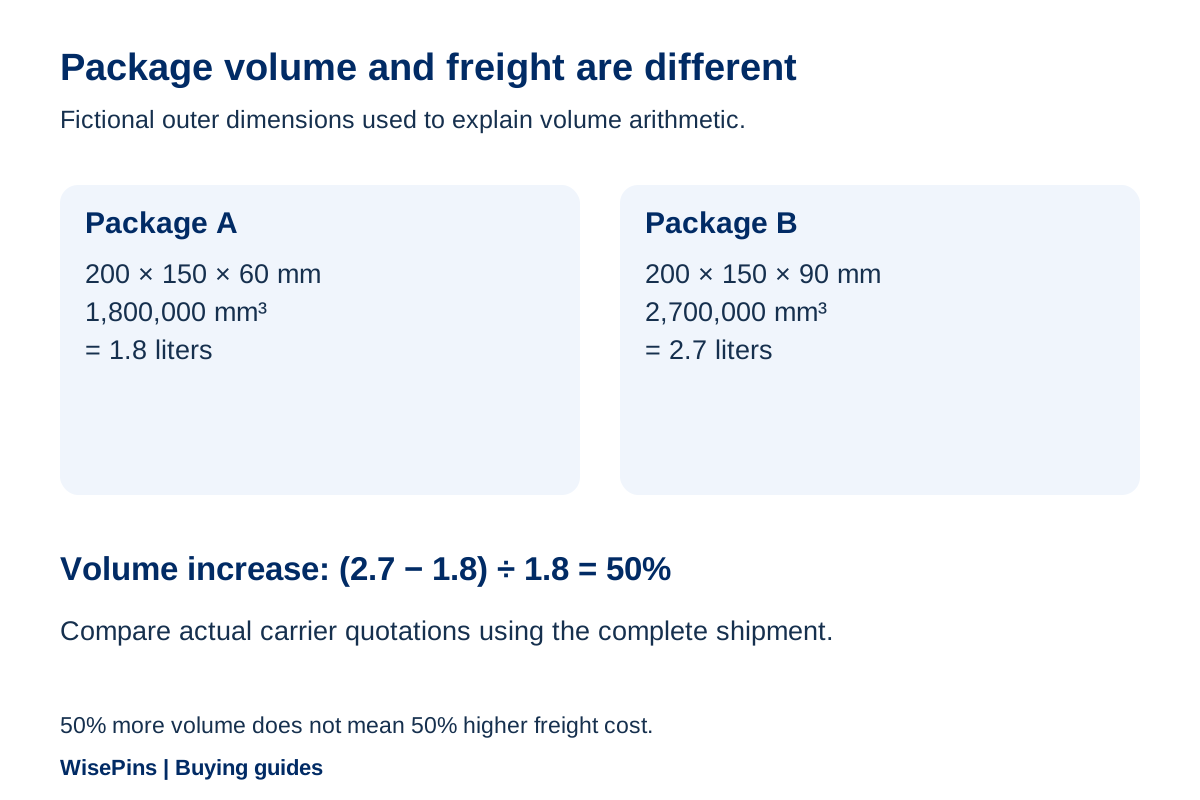
A simple volume example helps explain why depth deserves attention. A hypothetical outer package measuring 200 × 150 × 60 mm occupies 1.8 liters. At the same length and width but a depth of 90 mm, it occupies 2.7 liters: 50% more volume. This does not mean freight will rise by 50%; billable weight, packing arrangement and the carrier service still need to be confirmed.
| Compare consistently | Include in the request |
|---|---|
| Product or set | Same pin, attachment and number of items |
| Presentation | Same approved structural and printed requirements |
| Assembly | Identify who mounts, fits or packs each component |
| Quantity basis | Pieces, sets and inner packs clearly distinguished |
| Freight basis | Same destination, packed information and delivery scope |
| Exclusions | Identify charges and responsibilities not included |
For a potential saving, change one variable at a time. Compare a shallower box, a different presentation route or simpler printing while keeping the necessary protection and use requirements visible. Record the revised specification beside its revised total.
7. Approve the loaded sample and the packing specification
Check the actual pin, attachment, card or support, package and printed content together. Review the fit with the package closed as well as open, and check how the recipient removes the item.
Record:
- Pin design, artwork and attachment references.
- Packaging structure and artwork revision.
- Product orientation and any support arrangement.
- What was checked on the loaded sample.
- Inner-pack quantities and any agreed design separation or labels.
- Unresolved points, accepted changes and the release scope.
An approval of the front pin is not approval of later packaging artwork. Equally, approval of an empty box does not establish the loaded fit. Resolve the remaining checks before treating the complete order as approved.
WisePins produces after customers check the sample and confirm specifications, with product and packaging checks before shipment. Sampling is quoted for the actual design, process and quantity; do not assume a free packaging prototype or automatic fee credit. Use the sample approval checklist to keep the decisions clear.
8. Send a complete packaging brief
Use this outline to identify known requirements and open questions:
Pin design and quantity per design: [state]. Presentation use: retail, event or gifting [describe]. Complete product dimensions and attachment: [provide or request review]. Preferred packaging route: [state]. Required card/box wording and artwork revision: [identify]. Product position and support: [describe]. Assembly responsibility and pieces per set: [state]. Inner-pack sorting/labels: [request]. Destination and required receipt date: [state]. Please identify dimensions, materials, components, sampling, assembly, charges and delivery scope, with alternatives marked separately.
WisePins' pin minimum is 500 pieces per design, with different designs counted separately. Confirm the packaging quotation and any applicable packaging conditions for the chosen project rather than assuming a different component has the same quantity basis.
Retain the approved loaded sample reference, dimensions, attachment, packaging files and packing instructions for a reorder. If any of those elements change, ask which checks need to repeat. A new backing can affect an existing box even when the front design is unchanged.
Frequently Asked Questions
Start with a card for visible retail display and printed information; a pouch for a flexible enclosure and concealed gift presentation; or a paper gift box for a defined opening presentation or positioned set. Then compare the loaded sample, assembly work and packed dimensions. A card may need separate enclosure, while a pouch or box may still need support or transport packing.
No. Include the assembled backing, reverse projection, any card or support, closure and removal access. Label product, cavity, interior and exterior measurements separately, then confirm the complete loaded fit.
Do not assume it does. Ask for the presentation and shipment packing proposals and review any specific protection requirements for the product and route. An attractive package photo does not establish transit performance.
It depends on the quotation. Ask which components, printing, assembly and packing are included, separately charged or not applicable. Confirm whether your team or the supplier performs each step before comparing totals.
Request a review of the complete assembly. The new component may change mounting, occupied depth, removal or the presentation. Confirm any revised package, sample, cost or timing before approving the changed version.
Discuss the way your pins will be presented
Send the design or reference, quantity per design, intended presentation and destination. Explain which packaging decisions are settled and which need discussion. A photo or sketch can start that conversation without a finished technical brief.
Explore custom pins and badges or contact WisePins to discuss a complete product and packaging proposal.
Discuss Your Project