
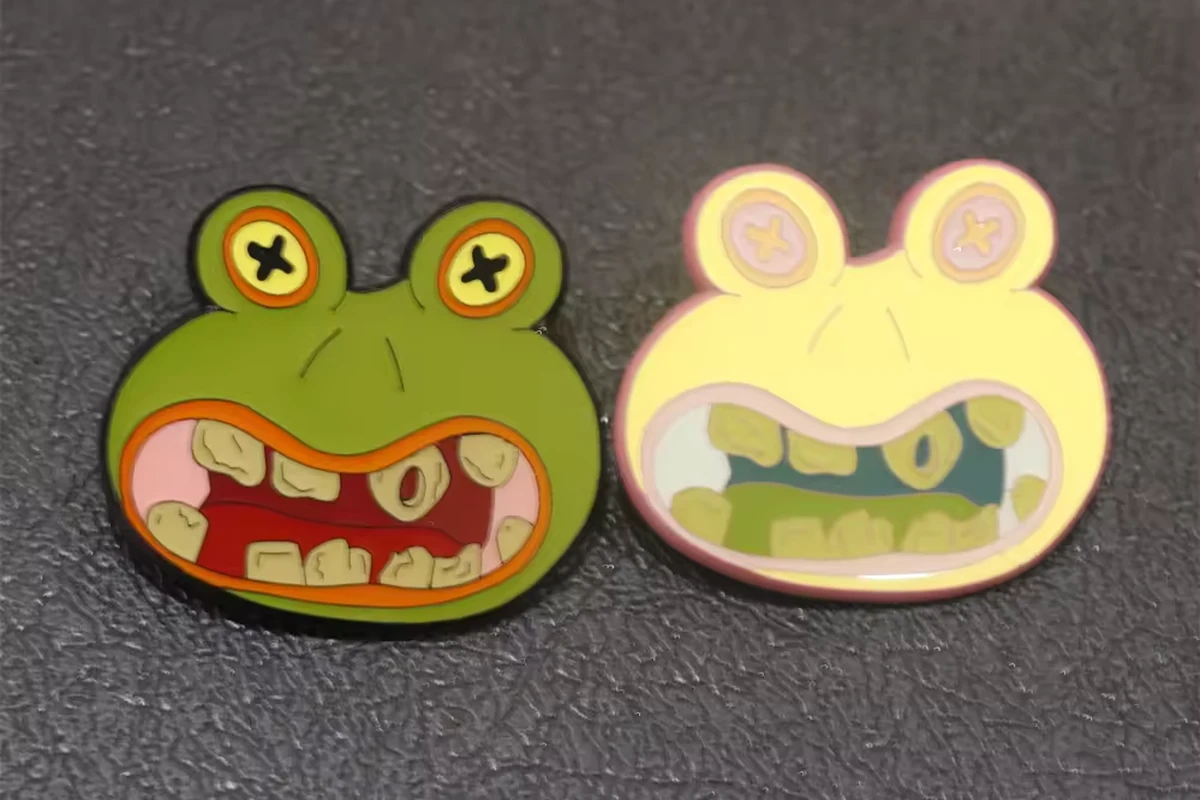
Choose soft enamel when you want visible, raised metal outlines and recessed color areas. Choose hard enamel when a smooth, polished face is central to the design. Both can suit a professional custom pin; the useful question is which surface best serves your artwork and the way the pin will be presented.
Budget matters, but compare the same specifications before deciding that one process is better value. A different size, backing or package can change the comparison. For a design with small wording, closely spaced details or a special finish, ask for an artwork review before committing to either option.
The surface distinction is explained in Made by Cooper’s manufacturing comparison. The guide below turns that distinction into a purchasing decision: what to specify, what to compare and what to inspect on the sample.
Soft and hard enamel: the practical differences
| What you are comparing | Soft enamel | Hard enamel | What to confirm |
|---|---|---|---|
| Face of the pin | Metal lines stand above the color fill | Color and metal are finished to a substantially level face | Whether the desired texture is visible and feels right |
| Design emphasis | Relief between outlines and color areas | A continuous, polished surface | Whether the important artwork remains clear |
| Small details | Still need enough space to produce clearly | Still need review at the finished size | The proposed treatment of lettering and narrow areas |
| Metal finish | Inspect the visible finish on the raised contours | Inspect the visible finish beside the polished color areas | The exact finish and its suitability for the proposed process; matching names do not prove matching samples |
| Quotation | Often the lower-priced starting option | Commonly carries additional finishing cost | A comparison with size, quantity and accessories held constant |
| Approval | Review the actual proposed construction | Review the actual proposed construction | Sample, final specifications and any agreed changes |
This table is a way to organize a decision, not a ranking of product quality. A well-executed textured pin can be the right finished product for a brand. A smooth pin can also be the wrong choice if its artwork no longer reads clearly.
What changes during manufacture?
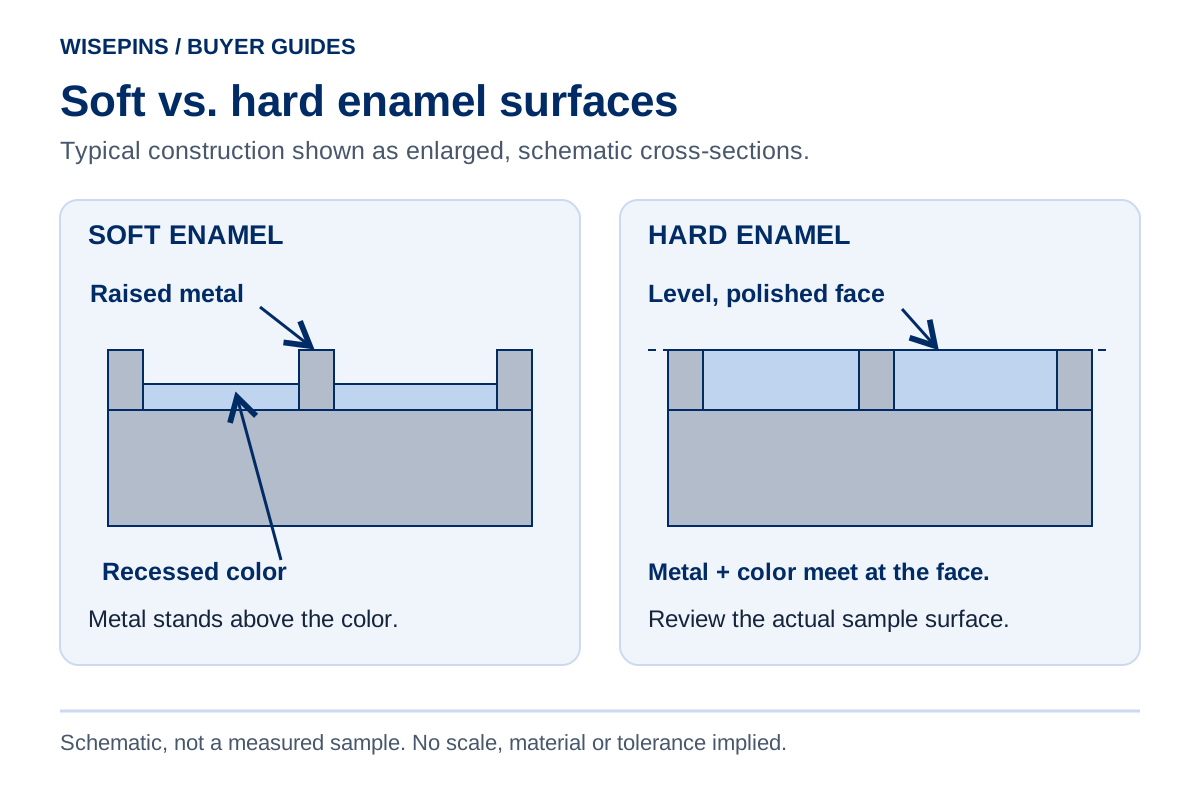
In a conventional soft enamel construction, the metal design provides raised boundaries around recessed areas. The metal receives its selected finish, and color fills the recesses while remaining below the surrounding lines.
For a typical polished hard enamel construction, the color is filled and cured, then the face is worked down so the color and metal meet at a substantially even surface. The finishing sequence differs from soft enamel. Signature Pins describes these two production routes.
That distinction explains why changing the process is more than changing a line on the purchase order. The supplier needs to check how the artwork will translate into the proposed construction.
Clarify what “hard enamel” means in the quotation
Supplier terminology needs attention. Traditional hard enamel and imitation hard enamel can use different coloring materials and processing methods. Jin Sheu distinguishes these constructions in its factory guide.
If the material itself matters to your project, ask the supplier to identify it. If your priority is appearance, specify the surface you want and approve a representative sample. The phrase “hard enamel” alone should not be your complete material specification.
Choose around the project, not a product label
Use the following table to write a first brief. The suggestions are starting points for discussion, not rules that assign one process to every customer in a particular industry.
| Your project requirement | Useful starting direction | The decision to make before approval |
|---|---|---|
| An illustrated pin whose outlines are part of its character | Discuss soft enamel | Do you want the metal contours to be felt as well as seen? |
| A restrained logo pin with a deliberately smooth face | Discuss hard enamel | Does the sample retain the logo’s proportions and clarity? |
| A school crest with a motto and several small symbols | Review the artwork before selecting the process | Which details must remain, and which can be simplified or enlarged? |
| A design based on a photograph or a gradient | Compare a printed approach | Is preserving the original image more important than an enamel surface? |
| A repeat order intended to match an existing pin | Start with the existing sample and specifications | Is the goal a close replacement, or an intentional redesign? |
| A project with a firm spending limit | Obtain comparable soft and hard enamel quotations | What changes, besides the enamel process, are included in each price? |
A small logo for staff recognition
Suppose your team wants a discreet logo pin for a jacket lapel. Start with the actual logo and the intended wearing position. If the brief calls for a smooth face, hard enamel is a sensible option to discuss. Then check the lettering and logo spacing at the proposed size.
Do not enlarge the pin merely to satisfy the process if the larger result no longer suits the garment. Compare an adjusted layout or a different construction before choosing. The objective is a recognizable, wearable logo, not simply a particular enamel label.
An illustrated design for a merchandise collection
A character, flower or emblem may use its outline as a strong visual feature. Ask whether raised metal contours would support that effect. Also look at the pin beside the backing card or packaging: the complete presentation may influence your choice more than a close-up photograph of the face.
You can use the WisePins design gallery to communicate shapes, themes and visual details you like. A reference image helps explain the direction; its appearance does not establish the material, exact dimensions or manufacturing specification for your own order.
A crest that contains too much information
List the elements that must survive: perhaps the organization’s name, one emblem and a date. Mark secondary decoration separately. Ask for the proposed layout at the intended finished size, then have someone who did not create the design read it.
If the wording is unclear, resolve that before choosing the final process. Changing from soft to hard enamel does not automatically solve a crowded layout. A larger size, clearer spacing or simpler design may be more useful. If continuous shading is essential, explore printed pins.
Compare quotations without changing the question
Soft enamel is generally described as the lower-cost option, while hard enamel involves additional finishing. This is a general comparison, also reflected in GS-JJ’s pin FAQs; it does not establish the price difference for your design.
Ask for two versions of the same brief. Use this sheet to make differences visible:
| Quote item | What both quotations should identify |
|---|---|
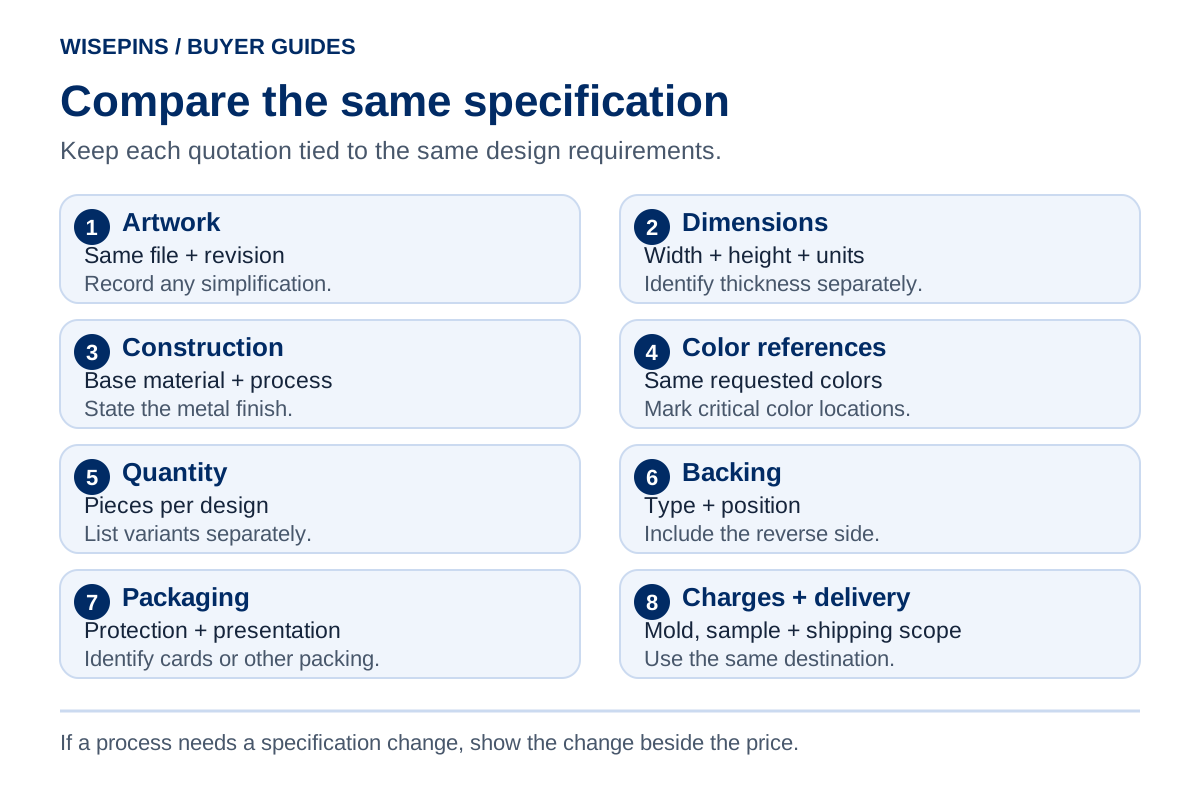
| Artwork | The same file and revision, including any proposed simplification |
| Finished dimensions | Width and height, with thickness separately identified |
| Construction | Base material, enamel process and specified metal finish |
| Color | The same requested colors and reference information |
| Quantity | Quantity per design, with variants listed separately |
| Backing | The proposed attachment and its position |
| Packaging | Individual protection, backing card or other agreed presentation |
| Additional charges | Any mold, sample or other separately charged items |
| Delivery | Destination, shipping scope and the basis of the schedule |
For example, imagine a soft enamel quotation includes an individual bag, while the hard enamel quotation includes a printed backing card and a different clutch. That comparison cannot tell you the cost of changing the enamel process. Request matching accessories first, or ask the supplier to separate the changes.
A simple comparison is:
Comparable project cost = product quantity × quoted unit price + separately quoted charges included in the comparison.
Check whether sample, packaging and shipping charges are already included before adding them. Use the same delivery scope for both versions. If a supplier must change the artwork or construction to make one version, record that change beside the price rather than hiding it in the notes.
At WisePins, the minimum is 500 pieces per design; different designs are counted separately. Sample fees are quoted according to the design, process and quantity. You can begin with an idea or reference image, then work through the remaining specifications before requesting the final comparison.
Review the artwork, then check the physical sample
A digital image can help settle layout, wording and proposed colors. It cannot let you feel a surface or check how the actual attachment sits against a garment. Separate those two approval tasks.
For a useful soft-versus-hard sample comparison, request the same artwork revision, outer dimensions, base material where feasible, color references, requested metal finish and backing. If one process requires a change, identify it on that sample's specification. Otherwise, a larger logo or different finish can influence your preference without showing which enamel surface suits the original brief.
Label the samples A and B. Place them side by side on the same neutral background, under the same light, facing the same direction. Read the wording at the intended wearing distance, then tilt each sample through the same angles to inspect its surface. Compare both on the intended garment or backing card. Record the sample ID, artwork revision, dimensions, process, finish, observation and decision together; a photograph without those details is a weak reference for a later order.
Before making the sample
- Identify the artwork version. Put all corrections on one current file so an earlier logo or spelling does not return to the discussion.
- Confirm dimensions. Check the proposed width and height at actual size, rather than judging only a magnified screen view.
- Identify the construction. Record the enamel process, base material and finish being proposed.
- Mark critical details. Highlight wording, symbols and color references that need particular attention.
- Include the back and presentation. Confirm the intended attachment and packaging, not only the front artwork.
When the sample arrives
| Check | Practical action | What to record |
|---|---|---|
| Overall appearance | View the pin normally, then tilt it to inspect the face and edges | Any visible gap in a color-filled area, patchy area or surface mark that needs review against the agreed appearance |
| Artwork | Compare with the approved file and read all wording | Missing strokes, joined letters, closed spaces inside letters or altered symbols, with their exact locations |
| Color and metal finish | Compare with the agreed references under consistent lighting | Which specific area differs, and whether the difference remains when both samples are viewed at the same angle |
| Dimensions | Check the sample against the agreed dimensions | The result and any questions for the supplier |
| Attachment | Check position, operation and the intended wearing arrangement | Any concern about orientation or fit |
| Packaging | Review the agreed package with the pin inside | Placement, wording and presentation changes |
Photograph a concern clearly and identify its location. “Please review the lettering at the bottom of the crest” is easier to act on than “the finish looks wrong.” Keep layout changes separate from questions about workmanship so the supplier can respond to each.
For example, “the opening inside the letter A is visible in the approved drawing but closed on sample B” identifies a result to resolve. “B looks less premium” leaves the supplier guessing whether you mean color, reflection, legibility or texture. These observations are review prompts, not a universal defect allowance or a substitute for agreed acceptance criteria.
The intended recessed fill of a soft enamel pin should not be mistaken for an incomplete hard enamel finish. Conversely, a surface difference should not be accepted just because a quotation uses the word “handmade.” Discuss the result against the agreed sample and specifications.
WisePins proceeds to bulk production after you review the sample and confirm the specifications. We check color and artwork, dimensions and appearance, backings, quantity and packaging, with identified problems addressed before shipment. See sample development and the production process for the next stages.
Frequently asked questions
The name does not mean the finished pin has a flexible, rubber-like face. It describes a construction with cured color sitting below raised metal boundaries. Expect a difference in surface height, rather than a soft cushion. Monterey’s soft enamel explanation describes the recessed color and raised metal relationship.
No. A smooth surface is a design preference, not a complete quality specification. Judge the actual pin against its approved artwork, construction and intended use. The enamel name alone does not tell you how securely the attachment works or whether the dimensions and packaging meet your order requirements.
A clear epoxy coating can be applied over some soft enamel constructions, creating a smoother outer surface. It does not turn the underlying process into hard enamel. Made by Cooper explains this distinction in its process comparison. Ask whether a coating is appropriate for the proposed design and inspect the finished sample before accepting it as an alternative.
Discuss a printed pin when the original image depends on continuous shading or photographic detail. Neither soft nor hard enamel should be selected on the assumption that changing the fill process will reproduce every feature of a digital image. Compare the proposed result with the elements you must preserve.
Ask the supplier to review the change before production proceeds. Request confirmation of any artwork adjustments, revised quotation and schedule, and whether a new sample is needed. Approval of one construction should not automatically stand as approval of the other; check the revised result before committing to the bulk order.
Discuss the design you want to make
If you are comparing soft and hard enamel for a new project, send us your artwork, reference image or idea and explain the surface you want. An estimated quantity and the way the pin will be used help start the discussion; you do not need to resolve every specification first.
Explore custom enamel pins or contact WisePins to work through the design, process and sample requirements.
Discuss Your Project