
Compare the complete quoted scope before comparing the price per pin. Use the same artwork revision, finished dimensions, process, quantity per design, backing, packaging and delivery basis. Then add any separately charged tooling, samples, packing and freight. An attractive unit price is useful only when you know what it buys.
This guide gives you a specification sheet, a worked comparison and a reusable request for quotation. It applies to the buying process for custom pins and badges; the actual construction and costs still depend on your product.
Start with a comparison sheet, not a price column
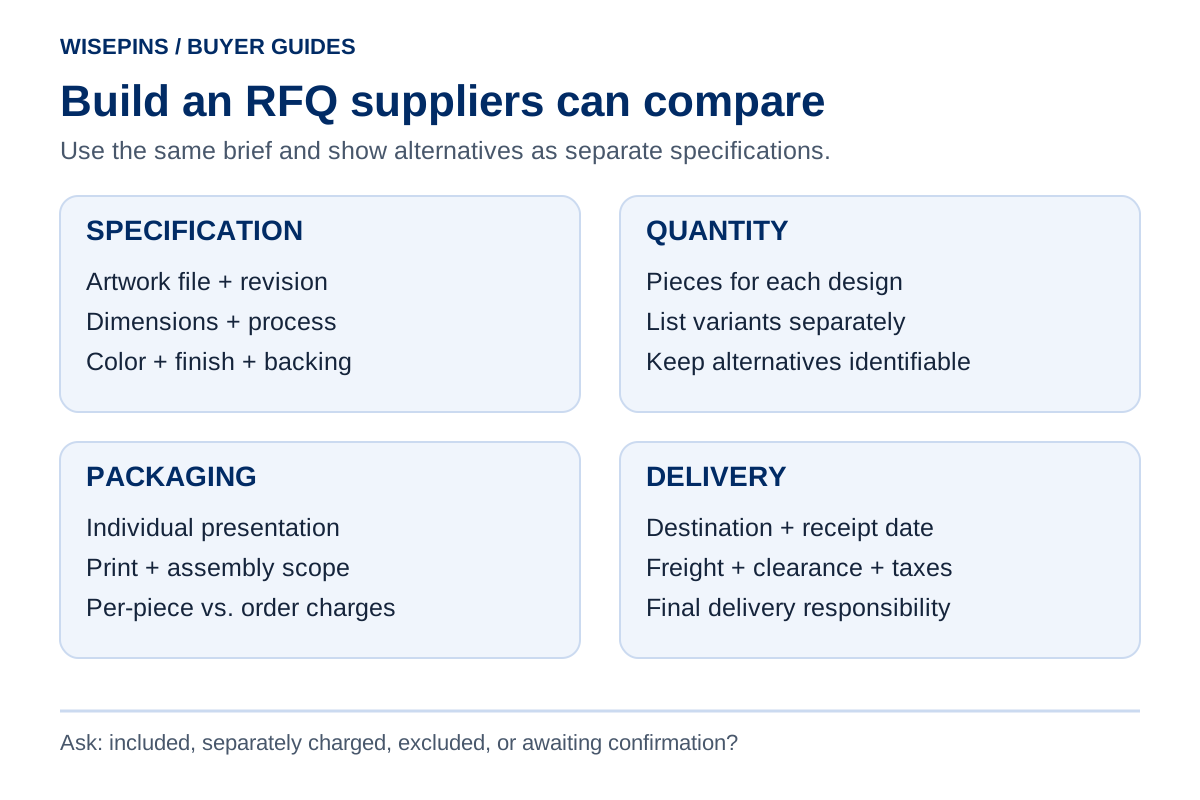
Send the same brief to each supplier. Ask them to mark a field as included, separately charged, excluded or awaiting confirmation. A blank cell is an unanswered question, not evidence that an item is free.
| Compare this field | Make it explicit | Why the difference matters |
|---|---|---|
| Artwork | File name, revision, front and reverse | Similar-looking files can contain different text, outlines or back details |
| Finished size | Width × height, units and thickness where specified | “30 mm” alone may not describe an irregular shape |
| Construction | Base material and manufacturing process | A process name or metal color does not identify the complete construction |
| Appearance | Color references, plating appearance and any coating | Suppliers may be quoting different ways to achieve a similar image |
| Attachment | Backing type, number and intended placement | Accessories and assembly must be part of the same comparison |
| Quantity | Pieces for each design, color version or other separately priced version | A combined order total can conceal different production quantities |
| Packaging | What each pin includes, plus any cards or presentation packaging | Loose pieces, bagged pieces and card-mounted pieces have different scopes |
| Development | Proof, tooling, physical sample and revision charges | These may be separate, included or conditional |
| Delivery | Destination, service, and responsibility for freight, clearance/brokerage, import duties/taxes and final delivery | An ex-factory product total and a delivered total are different budgets |
| Timing | Approval trigger, production estimate and dispatch or arrival requirement | Two quotes may assume different schedules |
Keep this sheet attached to the quotation. A comparison reconstructed from separate email threads is harder to check when an order changes.
Understand the specification behind the price
Material and finish are separate decisions
“Gold pin” usually describes an intended appearance without fully identifying the product. Your quote should distinguish the base material from the surface finish. A color description alone does not establish precious-metal content, coating thickness or a tested performance level.
If a material or finish requirement is essential, put it in the brief before pricing. If it is only a visual preference, say that too. This lets a supplier explain suitable alternatives without silently changing a mandatory requirement.
Compare processes against the same design goal
An enamel pin, a printed metal pin and a button badge are different product routes. A lower quotation for another route may be a useful alternative, but it needs a separate row, with the change identified.
Ask: “What changes in the finished product if we take this alternative?” Keep visual requirements, intended use and any approved brand details beside the answer. This makes a cost discussion specific enough to act on.
Ask what “complex design” means in your quote
A supplier should be able to identify the detail that needs work: a proposed cutout, additional printing, reverse-side detail, a surface treatment or another operation. Request an annotated proof when the explanation depends on a particular area of the artwork.
“Complexity” is a starting point for a conversation. It is not a specification you can compare between suppliers.
Separate one-time, per-piece and delivery charges
Put costs into three groups before calculating a total:
- Development and setup: any quoted artwork preparation, tooling, sampling, revisions or sample delivery.
- Order quantity costs: pins, attachments, individual packaging, card mounting and other separately quoted per-piece work.
- Order-level delivery costs: shipment preparation and transport within the quoted delivery scope.
List each charge once. If the unit price already includes a backing card, do not add the card again. If a sample charge is stated to be credited later, show the initial payment and the conditional credit separately until the credit is confirmed in writing.
Use this calculation for the purchase scope you are comparing:
Comparable quoted total = quantity × quoted unit price + separately charged setup/development + separately charged packaging/assembly + quoted delivery charges.
Use order totals for the added charges. If packaging or assembly is quoted per piece, multiply that rate by the relevant quantity before adding it. If it is already included in the product unit price, enter no separate charge for the same work.
Add any other identified costs that fall outside that quotation before you approve your full budget. Label the currency and delivery scope; do not call a subtotal a complete delivered cost if some charges remain unknown.
At WisePins, sample fees are quoted according to the design, process and quantity. A fixed sample price or automatic sample-fee credit should not be assumed.
Worked example: the lower unit price does not have the lower total
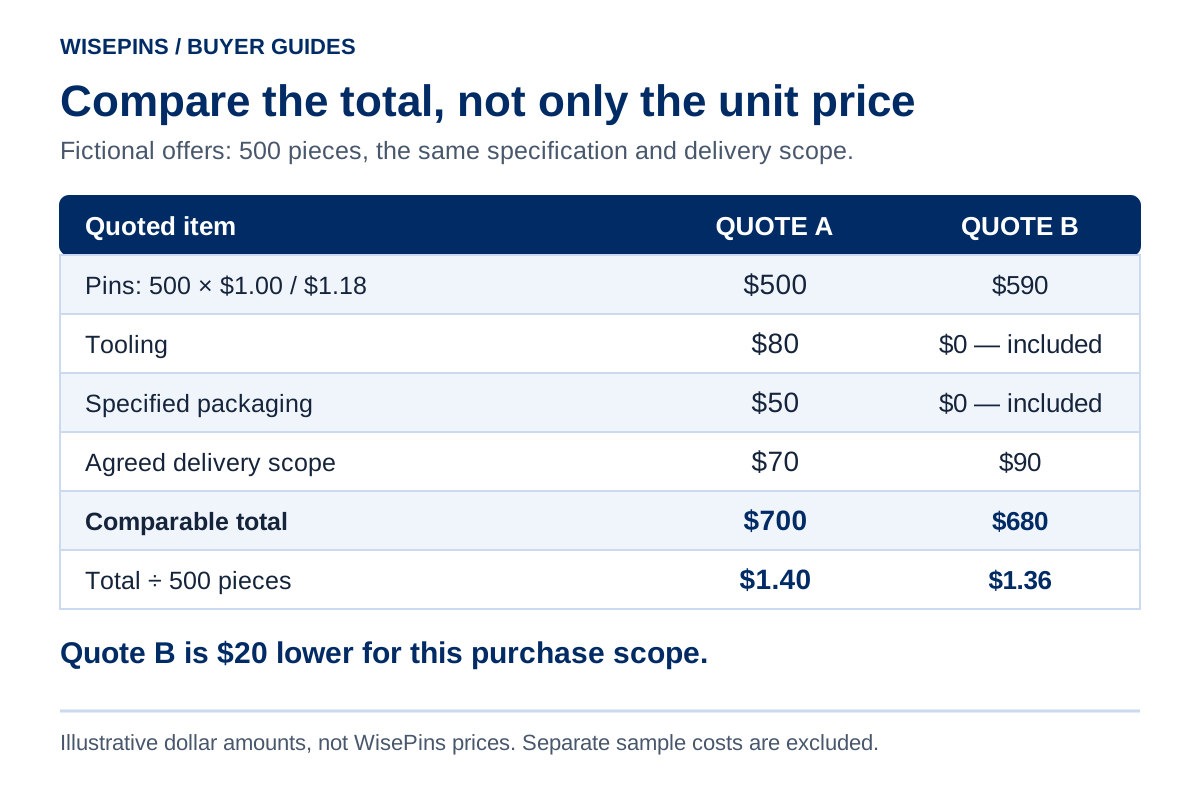
The following figures are invented to demonstrate the calculation. They are not WisePins prices or market price ranges. Both fictional offers cover the same 500-piece specification and delivery scope, and any separate sample costs are outside this example.
| Item | Fictional quote A | Fictional quote B |
|---|---|---|
| Quantity | 500 | 500 |
| Price per pin | $1.00 | $1.18 |
| Pin subtotal | $500 | $590 |
| Tooling | $80 | Included |
| Specified packaging | 500 × $0.10 = $50 | Included |
| Delivery within the agreed scope | $70 | $90 |
| Comparable total | $700 | $680 |
| Comparable total ÷ 500 | $1.40 per pin | $1.36 per pin |
Quote A looks cheaper in the unit-price column. Once the specified extras are included, quote B is $20 lower for this purchase scope.
This does not establish which supplier to choose. You still need to compare the agreed specification, sample, schedule and commercial terms. It does show why sorting a spreadsheet by unit price can produce the wrong shortlist.
If tooling can be reused for a later order, make a second calculation using the actual reorder conditions. Do not simply delete the tooling row: first confirm whether it is reusable for that design, what changes would require new work, and what conditions apply.
Identify the mold against the design and revision. Ask who holds it, whether a retention period or storage charge applies, whether it will still be available for the planned reorder, and how a size, reverse-side or artwork change affects reuse. Request the actual repeat-order charges and approval requirements. A previously paid mold fee does not, by itself, establish that the next order has no setup cost.
Compare quantities by design, not by the combined total
Three designs totaling 1,500 pins are not the same production request as 1,500 identical pins. Record each design and its quantity separately, then ask which variations can share any quoted development work. Do not decide that from the visible similarity of the designs.
WisePins has a minimum of 500 pieces per design. Different designs are counted separately. An order of 300 pieces of one design and 200 of another does not meet that minimum by combining them.
For quantity alternatives, keep the product unchanged. Ask for the same approved specification at 500 and 1,000 pieces of one design, for example. If a supplier changes the material, size or packaging to reach a target price, record that as an alternative specification.
Lower cost per piece is also different from lower cash outlay. Suppose a larger run reduces the unit price but leaves you holding stock you cannot use. Compare the total payment, expected usage and storage needs before choosing a quantity bracket.
Worked example: 500 versus 1,000 pieces
This separate, fictional example compares the same product and packaging at two quantities. All figures are USD; they are teaching figures, not WisePins prices. The stated setup and delivery charges are the only additional charges in this example's scope. Any actual costs outside that scope would need to be added to both budgets.
| Cost or decision | 500 pieces | 1,000 pieces |
|---|---|---|
| Product price, including the same packaging | $1.20 per piece | $0.95 per piece |
| Product subtotal | $600 | $950 |
| Setup for this order | $80 | $80 |
| Delivery within the same agreed service scope | $70 | $100 |
| Total payment within this scope | $750 | $1,130 |
| Total divided by quantity | $1.50 | $1.13 |
| Stock left if the project uses 500 pieces | 0 | 500 pieces |
The 1,000-piece option lowers the average quoted cost by $0.37 per pin, but requires $380 more total payment. It adds 500 pieces at an incremental $0.76 each ($380 ÷ 500). That extra stock may suit a continuing program; it needs a different justification for a dated event or a logo scheduled to change. Compare likely use and storage costs with the extra payment, then confirm when each payment is due.
Find packaging and freight differences early
“Individual packaging included” is incomplete unless you know what it includes. Specify whether each pin is bagged, mounted on a backing card, placed in a gift box or packed in another agreed format. Confirm whether assembly and any packaging print are in the price.
Packaging can also affect the shipment. Ask for the estimated number of cartons, packed dimensions and weight when comparing delivery options. For parcel services, dimensional weight may affect the billable weight; FedEx explains the distinction between actual and dimensional weight. The applicable calculation depends on the carrier and service.
Compare delivery quotations using the same destination and included service. Ask separately whether clearance or brokerage, import duties and taxes, and final delivery are included, excluded or still to be confirmed, and who is responsible for each. A freight amount alone does not settle those questions. A product saving is not a saving to the project if an essential packing or delivery requirement has been omitted.
Reduce cost by changing one variable at a time
Start by separating requirements into must keep, open to alternatives and not yet decided. This prevents a supplier from solving the wrong problem when asked to reduce a quotation.
| Option to discuss | Keep fixed during the comparison | Ask the supplier to explain |
|---|---|---|
| A different size | Artwork and intended use | Which details need adjustment, and whether accessories or packaging change |
| A different process | Essential logo details and visual priorities | What the buyer will see or feel differently |
| Simpler packaging | Protection and distribution needs | What presentation or handling work moves to the buyer |
| A higher quantity of one design | Complete product specification | Total payment, cost per piece and any extra stock |
| Removing an optional feature | All mandatory requirements | Which operation or component disappears from the quoted scope |
Get a revised total and updated specification after each meaningful change. Avoid comparing the cheapest line from several incompatible versions as though it were one available product.
For every retained option, ask whether another sample or approval is needed. A saving that changes the approved appearance must be reviewed before it becomes the production instruction.
Check commercial terms and plan approval time
Before accepting the total, record the commercial conditions that keep it usable:
| Condition | Question to settle in writing |
|---|---|
| Quotation validity | Until what date does the offer apply, and will a late approval require a new price or schedule? |
| Currency and charges | Which currency is payable, and are transfer, conversion or other identified payment charges included or separate? |
| Payment stages | What amount is due at each stage, what triggers it, and which payment or approval starts the next stage? |
| Changes after approval | How will artwork, quantity, packing or destination changes affect charges and the delivery estimate? |
| Reorder tooling | Which mold/design revision is reusable, under what retention conditions, and what costs or checks remain? |
These are questions for the individual quotation, not standard WisePins payment percentages or free-storage terms. Put the agreed amounts and triggers on your buying schedule alongside sample and artwork approvals; the full order total and the cash due today are different figures.
Allow time for review, sampling and production
A quotation needs a schedule basis. Ask what starts the production estimate, which approvals must be complete and whether the delivery requirement is a dispatch date or an arrival date.
At WisePins, sample making usually takes about 10–15 days, with approximately another 10 days for projects requiring new mold development. Bulk production usually takes about 20–25 days, depending on the specification and production arrangements. These are production-related estimates, not a guaranteed order-to-door schedule; transport and buyer review must be planned separately.
Check the sample development and production process pages when preparing your approval plan. If your date is fixed, provide it at the first conversation so the feasible route can be discussed before a quotation is accepted.
A request for quotation you can reuse
Copy this outline and complete what you know. Mark an undecided field as “please recommend” rather than making a guess that becomes an accidental requirement.
Project and use: What the pins are for and who will use them.
Artwork: File name/revision, front and reverse references, and essential details.
Dimensions: Finished width × height in mm; any required thickness.
Process and appearance: Preferred route, color references, finish and optional effects. Please identify suitable alternatives separately.
Quantity: Pieces per design; list each variation separately.
Backing: Preferred type, count and placement, or request a recommendation.
Packaging: Individual presentation and any print or assembly required.
Development: Please identify tooling, sample, revision and sample-delivery charges, plus any conditions for reuse or credit.
Destination and date: Delivery location and required arrival date; identify any flexibility. State whether freight, clearance/brokerage, import duties/taxes and final delivery are included, excluded or awaiting confirmation, and who handles each.
Quotation response: Currency, unit price, inclusions, separate charges, total, timing assumptions, validity date, payment amounts and triggers, reorder tooling conditions and exclusions.
You do not need a finished technical brief to start with WisePins. An idea, photo, logo or sketch is enough for an initial discussion. The purpose of the completed sheet is to make the final quotation comparable after the open choices have been resolved.
Five questions buyers ask about custom pin quotes
A useful answer needs a defined design, size, process, quantity per design, backing, packaging and delivery destination. Ask for a product unit price and a complete breakdown of separately charged items. A price range without those assumptions cannot tell you the cost of your own project.
The logo may be the same while the proposed product is different. Compare dimensions, material, process, finish, attachments, packaging, development charges and delivery scope. Ask each supplier to identify any substitutions or assumptions that are not explicit in your brief.
That depends on the quotation. Ask for each charge to be marked included, separate or not applicable, and check any conditions attached to a credit or reorder. WisePins quotes sample fees individually; do not assume a universal fee, free sampling or an automatic refund.
WisePins requires 500 pieces per design, with different designs calculated separately. List the quantity for each design in your request. If you are considering color or artwork variations, ask how those versions will be grouped and priced before building your budget.
Choose between quotations that meet the agreed specification and delivery needs. Then consider the sample, clarity of the production instructions, approval route and terms. A low total with unresolved details is an incomplete offer to clarify, rather than a confirmed saving.
Prepare a quotation that your team can approve
Keep the specification sheet, latest artwork, quotation and sample decisions together. Before placing the order, check that the selected total still matches the exact version your team approved.
Send WisePins your idea or artwork, quantity per design, intended use and destination. We can discuss the remaining choices and prepare a quotation around the product you need. Discuss your custom pin project.
Four things to keep beside every quote: the artwork revision, complete specification, itemized total and approval schedule.
Discuss Your Project